
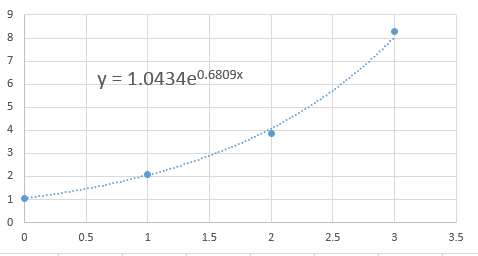
In this post I will be showing you how to write a code that fits the data-points to an exponential function, like:
where, A & B are some constants that we will determine.

We will be using the Least Squares Method (also known as Chi square minimization) to achieve this.
Let’s say you have n data points: 

Then the fitted function can be calculated by minimizing the error(difference between the actual and fitted point):
minimize:
where
But this will give us alot of problem as doing that is not easy and a topic for another post, and very mathematical.
To cut the long story short, what we do instead is, we apply a trick, that is, we take the logarithm of eq(1) to get rid of the exponential
and applying a quick change of variables as :
we get,
which is exactly the equation of a straight line, and therefore, it becomes a problem of linear fitting. And we have already seen how to write a Linear Fitting program. We will use the following formulae from there:





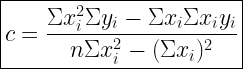
You can refer to this link for a detailed proof.
From ‘c’ we calculate the value of A using:

So you will need to have some code for the user two enter the data-points or you could add them manually by initializing the arrays.
Once you have the data-points stored in the x and y arrays,
you can use the following code to find out the value of ‘A‘ and ‘B‘, which are the coefficients of exponential fitting funtion.
CODE:
/******************************************************
*************Chi-square fitting**************
Exponential Fitting: y=Ae^bx
******************************************************/
#include<stdio.h>
#include<math.h>
/*****
Function that calculates and returns the slope of the best fit line
Parameters:
N: no. of data-points
x[N]: array containing the x-axis points
y[N]: array containing the corresponding y-axis points
*****/
double slope(int N, double x[N], double y[N]){
	double m;
	int i;
	double sumXY=0;
	double sumX=0;
	double sumX2=0;
	double sumY=0;
	for(i=0;i<N;i++){
		sumXY=sumXY+x[i]*y[i];
		sumX=sumX+x[i];
		sumY=sumY+y[i];
		sumX2=sumX2+x[i]*x[i];
	}
	sumXY=sumXY/N;
	sumX=sumX/N;
	sumY=sumY/N;
	sumX2=sumX2/N;
	m=(sumXY-sumX*sumY)/(sumX2-sumX*sumX);
	return m;
}
/*****
Function that calculates and returns the intercept of the best fit line
Parameters:
N: no. of data-points
x[N]: array containing the x-axis points
y[N]: array containing the corresponding y-axis points
*****/
double intercept(int N, double x[N], double y[N]){
	double c;
	int i;
	double sumXY=0;
	double sumX=0;
	double sumX2=0;
	double sumY=0;
	for(i=0;i<N;i++){
		sumXY=sumXY+x[i]*y[i];
		sumX=sumX+x[i];
		sumY=sumY+y[i];
		sumX2=sumX2+x[i]*x[i];
	}
	sumXY=sumXY/N;
	sumX=sumX/N;
	sumY=sumY/N;
	sumX2=sumX2/N;
	c=(sumX2*sumY-sumXY*sumX)/(sumX2-sumX*sumX);
	return c;
}
main(){
	int N;
	printf("Enter the no. of data-points:\n");
	scanf("%d",&N);
	double x[N], y[N], Y[N];
	printf("Enter the x-axis values:\n");
	int i;
	for(i=0;i<N;i++){
		scanf("%lf",&x[i]);
	}
	printf("Enter the y-axis values:\n");
	for(i=0;i<N;i++){
		scanf("%lf",&y[i]);
	}
	for(i=0;i<N;i++){
		Y[i]=log(y[i]);
	}
	printf("The exponential fit is given by the equation:\n");
	double m=slope(N,x,Y);
	double c=intercept(N,x,Y);
	double A, b; //y=Ae^bx
	A=exp(c);
	b=m;
	printf("y = %lf e^(%lf)x",A,b);
}
OUTPUT:
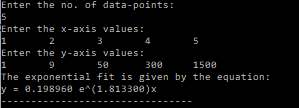
So that’s it.
You now have the value of ‘A’ and ‘B’ and thus the exponential fit:

You can refer to the following links for more info:
Exponential Fitting – Lab Write-Up
Exponential Fitting – C++ Program
Exponential Fitting – Scilab Code
Curve Fit Tools – Android App (using the above code)
Curve Fit Tools – Documentation
Curve Fit Tools – Play Store
Curve Fit Tools – GitHub Repository
Curve Fitters – Scilab Toolbox
Hope you found this post useful.
If you have any questions/doubts drop them in the comments section down below.

I’m a physicist specializing in computational material science with a PhD in Physics from Friedrich-Schiller University Jena, Germany. I write efficient codes for simulating light-matter interactions at atomic scales. I like to develop Physics, DFT, and Machine Learning related apps and software from time to time. Can code in most of the popular languages. I like to share my knowledge in Physics and applications using this Blog and a YouTube channel.