
Learning begins long before formal lessons start. Shapes, colors and gentle patterns spark interest even in the smallest learners. This playful computational chemistry alphabet poster created with Nanobanana brings that spark into a world that normally feels abstract and technical. It turns complex research ideas into soft, friendly illustrations that toddlers can enjoy while older readers smile at the hidden meaning.
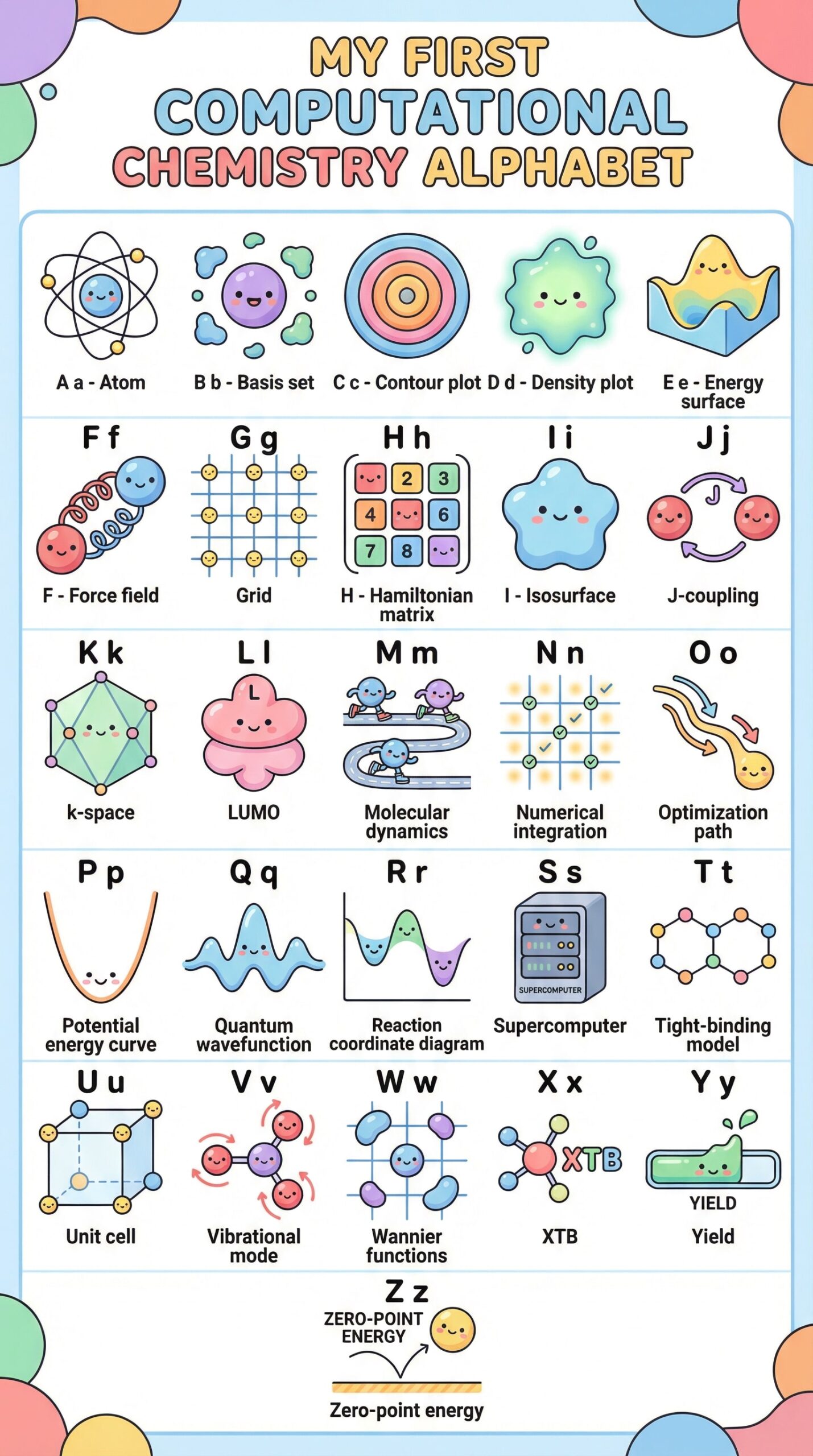
The poster follows the full English alphabet. Each letter appears in upper and lower case, paired with a cheerful cartoon inspired by a real concept from computational chemistry. The look stays warm and simple. Rounded fonts. Calm bright tones. Clear spacing. Every square on the grid shows a tidy scene that invites exploration without crowding the page.
A is for a tiny atom with a bright face in the middle.
B shows a handful of floating basis blobs.
C displays smooth contour rings.
D shares a cloud of soft electron density.
E lifts a small energy surface with gentle hills.
The visuals stay light and soft. You see springs for force fields. Smiling dots for computational grids. A blocky Hamiltonian with neat colored squares. A friendly isosurface with smooth edges. Even J-coupling becomes two tiny nuclei chatting across a curved arrow.
Moving down the alphabet, concepts grow broader. K introduces a simple k-space shape. L shows a LUMO lobe with a quiet grin. M turns molecular dynamics into atoms racing along a track. N brings in numerical integration using steady grid points. O follows an optimization path that glides downhill to a shy minimum.
The next row highlights classic curves. P shows a potential energy bowl. Q brings a quantum wave with relaxed rises and falls. R shows a reaction coordinate that moves across gentle peaks. S turns a supercomputer into a steady smiling server. T offers a tidy tight-binding lattice.
The final set explores structures and motion. U has a neat unit cell. V shows atoms dancing in a vibrational mode. W offers localized Wannier blobs on a simple lattice. X nods to XTB. Y shows yield rising in a friendly progress bar. Z bounces above the ground as zero-point energy.
The result is a soft doorway into a field that often feels tall and distant. None of the ideas are shown with heavy detail. Each picture hints at the essence rather than the full theory. Toddlers see shapes and smiles. Students see familiar patterns. Researchers see their tools turned into playful characters.
This kind of design helps make advanced science feel welcoming. It celebrates curiosity at every age. It invites parents, teachers and scientists to share one gentle page and talk about atoms, waves, surfaces and paths in a relaxed way. The poster shows that even technical areas have room for warmth, color and imagination.
If you want science to feel friendly from the very beginning, this alphabet is a gentle place to start.

I’m a physicist specializing in computational material science with a PhD in Physics from Friedrich-Schiller University Jena, Germany. I write efficient codes for simulating light-matter interactions at atomic scales. I like to develop Physics, DFT, and Machine Learning related apps and software from time to time. Can code in most of the popular languages. I like to share my knowledge in Physics and applications using this Blog and a YouTube channel.