
In the last post I discussed, how to evaluate a Sine series for a given value of 
In this post, I will show you how to modify that program to evaluate the sine series upto desired accuracy.
To do that, instead of running the loop upto n,(to evaluate and sum the n terms) we would use a do-while loop which will run until the desired accuracy is reached.
That is till, the ratio:
accuracy=
This will be our terminating condition for the do-while loop.
Therefore, the C program to find the sin(x), correct upto a given accuracy, can be written as shown below.
PROGRAM:
/********************************
******INFINITE SERIES SUM**********
Series: sin(x) = x - (x^3/3!) + (x^5/5!) + .....
********************************/
#include<stdio.h>
#include<math.h>
main(){
	int i=1;
	double x,t0,t1,R,sum,eps;
	printf("Enter the value of x:\n");
	scanf("%lf",&x);
	printf("Enter the desired accuracy: ");
	scanf("%lf",&eps);
	//Initialize First Term
	t0=x;
	//Make sum equal to the first term
	sum=t0;
	do{
		//Find the ratio of the second term to the first term using already known relation
		R=-(x*x)/(2*i+1)/(2*i);
		//Calculate the second term
		t1=R*t0;
		//find the new sum
		sum=sum+t1;
		t0=t1;
		i++;
		//keep on summing terms until the required accuracy is reached
	}while(fabs(t1/sum)>eps);
	printf("\nThe sum is: %f with %d terms",sum,i);
}
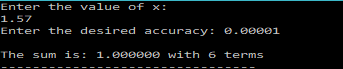
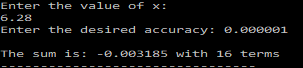
OUTPUT:

I’m a physicist specializing in computational material science with a PhD in Physics from Friedrich-Schiller University Jena, Germany. I write efficient codes for simulating light-matter interactions at atomic scales. I like to develop Physics, DFT, and Machine Learning related apps and software from time to time. Can code in most of the popular languages. I like to share my knowledge in Physics and applications using this Blog and a YouTube channel.