
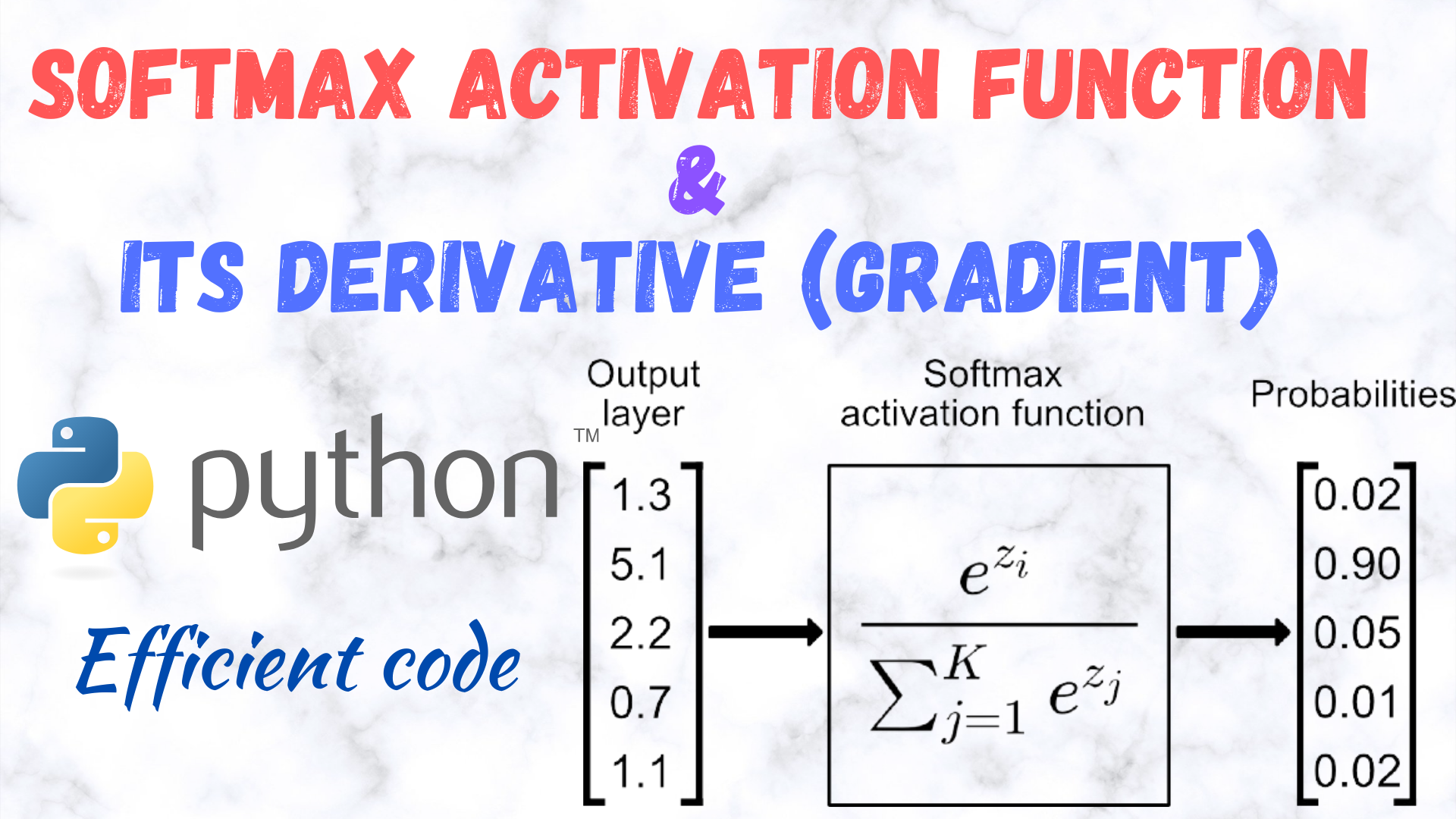
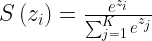
The mathematical definition of the Softmax activation function is
with the derivative defined as

The Softmax function and its derivative for a batch of inputs (a 2D array with nRows=nSamples and nColumns=nNodes) can be implemented in the following manner:
Softmax simplest implementation
import numpy as np
def Softmax(x):
    '''
    Performs the softmax activation on a given set of inputs
    Input: x (N,k) ndarray (N: no. of samples, k: no. of nodes)
    Returns:
    Note: Works for 2D arrays only(rows for samples, columns for nodes/outputs)
    '''
    max_x = np.amax(x, 1).reshape(x.shape[0],1) # Get the row-wise maximum
    e_x = np.exp(x - max_x ) # For stability
    return e_x / e_x.sum(axis=1, keepdims=True)
Softmax gradient (technically jacobian) simplest implementation
import numpy as np
def Softmax_grad(x): # Best implementation (VERY FAST)
    '''Returns the jacobian of the Softmax function for the given set of inputs.
    Inputs:
    x: should be a 2d array where the rows correspond to the samples
        and the columns correspond to the nodes.
    Returns: jacobian
    '''
    s = Softmax(x)
    a = np.eye(s.shape[-1])
    temp1 = np.zeros((s.shape[0], s.shape[1], s.shape[1]),dtype=np.float32)
    temp2 = np.zeros((s.shape[0], s.shape[1], s.shape[1]),dtype=np.float32)
    temp1 = np.einsum('ij,jk->ijk',s,a)
    temp2 = np.einsum('ij,ik->ijk',s,s)
    return temp1-temp2
Please note, and I can’t stress this enough, the above and the following implementations are only tested and fine-tuned for a batch of inputs, i.e., the expected input for the functions is a 2d array with rows representation different samples, and columns representing different nodes.
However, these implementations can be further accelerated (sped-up) by using Numba (https://numba.pydata.org/). Numba is a Just-in-time (JIT) compiler that
translates a subset of Python and NumPy code into fast machine code.
To use numba, install it as:
pip install numba
Also, make sure that your numpy is compatible with Numba or not, although usually pip takes care of that. You can get the info here: https://pypi.org/project/numba/
Accelerating the above functions using Numba is quite simple. Just modify them in the following manner:
Softmax NUMBA implementation
from numba import njit
@njit(cache=True,fastmath=True)  # Best implementation (VERY FAST)
def Softmax(x):
    '''
    Performs the softmax activation on a given set of inputs
    Input: x (N,k) ndarray (N: no. of samples, k: no. of nodes)
    Returns:
    Note: Works for 2D arrays only(rows for samples, columns for nodes/outputs)
    '''
    max_x = np.zeros((x.shape[0],1),dtype=x.dtype)
    for i in range(x.shape[0]):
        max_x[i,0] = np.max(x[i,:])
    e_x = np.exp(x - max_x)
    return e_x / e_x.sum(axis=1).reshape((-1, 1)) # Alternative of keepdims=True for Numba compatibility
Softmax derivative (jacobian) NUMBA implementation
from numba import njit
@njit(cache=True,fastmath=True)
def Softmax_grad(x): # Best implementation (VERY FAST)
    '''Returns the jacobian of the Softmax function for the given set of inputs.
    Inputs:
    x: should be a 2d array where the rows correspond to the samples
        and the columns correspond to the nodes.
    Returns: jacobian
    '''
    s = Softmax(x)
    a = np.eye(s.shape[-1])
    temp1 = np.zeros((s.shape[0], s.shape[1], s.shape[1]),dtype=np.float32)
    temp2 = np.zeros((s.shape[0], s.shape[1], s.shape[1]),dtype=np.float32)
    # Einsum is unsupported with Numba (nopython mode)
    # temp1 = np.einsum('ij,jk->ijk',s,a)
    # temp2 = np.einsum('ij,ik->ijk',s,s)
    for i in range(s.shape[0]):
        for j in range(s.shape[1]):
            for k in range(s.shape[1]):
                temp1[i,j,k] = s[i,j]*a[j,k]
                temp2[i,j,k] = s[i,j]*s[i,k]

    return temp1-temp2
This is quite fast and competitive with Tensorflow and PyTorch (https://github.com/manassharma07/crysx_nn/blob/main/benchmarks_tests/Performance_Activation_Functions_CPU.ipynb).
It is in fact also used in the CrysX-Neural Network library (crysx_nn)
Furthermore, the above implementations can be further accelerated using Cupy (CUDA), if using single precision (float32) is not a problem.
CuPy is an open-source array library for GPU-accelerated computing with Python. CuPy utilizes CUDA Toolkit libraries to make full use of the GPU architecture.
The Cupy implementations look as follows:
import cupy as cp
def Softmax_cupy(x):
    '''
    Performs the softmax activation on a given set of inputs
    Input: x (N,k) ndarray (N: no. of samples, k: no. of nodes)
    Returns:
    Note: Works for 2D arrays only(rows for samples, columns for nodes/outputs)
    '''
    max_x = cp.amax(x, 1).reshape(x.shape[0],1)
    e_x = cp.exp(x - max_x) # For stability as it is prone to overflow and underflow
#     return e_x / e_x.sum(axis=1, keepdims=True) # Alternative 1
    return e_x / e_x.sum(axis=1).reshape((-1, 1)) # Alternative 2
def Softmax_grad_cupy(x): # Best implementation (VERY FAST)
    '''Returns the jacobian of the Softmax function for the given set of inputs.
    Inputs:
    x: should be a 2d array where the rows correspond to the samples
        and the columns correspond to the nodes.
    Returns: jacobian
    '''
    s = Softmax_cupy(x)
    a = cp.eye(s.shape[-1])
    temp1 = cp.zeros((s.shape[0], s.shape[1], s.shape[1]),dtype=cp.float32)
    temp2 = cp.zeros((s.shape[0], s.shape[1], s.shape[1]),dtype=cp.float32)
    temp1 = cp.einsum('ij,jk->ijk',s,a)
    temp2 = cp.einsum('ij,ik->ijk',s,s)
    return temp1-temp2
The above code is also used in the crysx_nn library.
To see how the crysx_nn implementations of Softmax compare with TensorFlow and PyTorch, click here.
I hope you found this information useful.
If you did, then don’t forget to check out my other posts on Machine Learning and efficient implementations of activation/loss functions in Python.

I’m a physicist specializing in computational material science with a PhD in Physics from Friedrich-Schiller University Jena, Germany. I write efficient codes for simulating light-matter interactions at atomic scales. I like to develop Physics, DFT, and Machine Learning related apps and software from time to time. Can code in most of the popular languages. I like to share my knowledge in Physics and applications using this Blog and a YouTube channel.