
Secant Method, is a Numerical Technique to find the root of an algebraic or transcendental equation.
The root is approximated by drawing secant lines repeatedly.
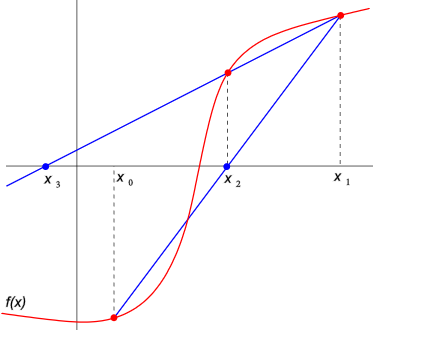
A secant line is a line joining two points on a function. Secant method requires two initial guesses(x0 and x1), to draw the first secant line. The root of this line(x2), that is, where this line touches the x-axis, becomes the new point, and now a secant line is drawn between the new point(x2) and one of the last points(x1).
This process is repeated until a root is found upto a certain tolerance.
The method is similar to Bisection Method, in that it requires two initial guesses, but still a lot different, as the guesses don’t require to bracket(enclose) the root. Moreover, unlike Bisection Method, Secant Method may not always converge, so it might be a good idea to have a limit for the maximum iterations to be performed.
So, the program would ask the user to enter two initial guesses:x1 and x2.
Then, it will calculate the new point(x3) using the formula:

PROGRAM (Simple Version):
/***********************************
*********SECANT METHOD**************
***********************************/
#include<stdio.h>
#include<math.h>
/*Function whose root is to be determined*/
double f(double x){
	return x*x-4;
}
main(){
	int iter=1,maxSteps;
	double x1,x2,x3,eps;
	printf("Enter the accuracy desired: \n");
	scanf("%lf",&eps);
	printf("Enter the intial guesses: \nx1 = ");
	scanf("%lf",&x1);
	printf("x2 = ");
	scanf("%lf",&x2);
	printf("Enter the max number of iterations to be performed: ");
	scanf("%d",&maxSteps);
	printf("iter\tx1\t\tx2\t\tx3\t\tf(x3)\n");
	printf("___________________________________________________________________\n");
	do{
		x3=(x1*f(x2)-x2*f(x1))/(f(x2)-f(x1));
		printf("%d\t%lf\t%lf\t%lf\t%lf\n",iter,x1,x2,x3,f(x3));
		x1=x2;
		x2=x3;
		iter++;
	}while(fabs(f(x3))>eps&&iter<=maxSteps);
	printf("\nOne of the roots is: %lf",x3);
}
OUTPUT:
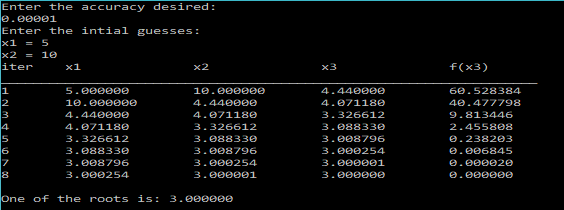
For x^3-27:
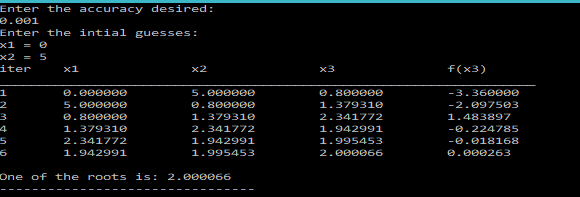
For x*x-4:
PROGRAM (USING FUNCTIONS)
/***********************************
*********SECANT METHOD**************
***********************************/
#include<stdio.h>
#include<math.h>
/*Function whose root is to be determined*/
double f(double x){
	return x*x-4;
}
/*Function that returns the root from Secant Method*/
double secant(double f(double x), double x1, double x2, double eps, int maxSteps){
	int iter=1;
	double x3;
	do{
		x3=(x1*f(x2)-x2*f(x1))/(f(x2)-f(x1));
		x1=x2;
		x2=x3;
		iter++;
	}while(fabs(f(x3))>eps&&iter<=maxSteps);
	return x3;
}
/*Secant Method Function that tabulates the values at each iteration*/
double secantPrint(double f(double x), double x1, double x2, double eps, int maxSteps){
	int iter=1;
	double x3;
	printf("___________________________________________________________________\n");
	printf("iter\tx1\t\tx2\t\tx3\t\tf(x3)\n");
	printf("___________________________________________________________________\n");
	do{
		x3=(x1*f(x2)-x2*f(x1))/(f(x2)-f(x1));
		printf("%d\t%lf\t%lf\t%lf\t%lf\n",iter,x1,x2,x3,f(x3));
		x1=x2;
		x2=x3;
		iter++;
	}while(fabs(f(x3))>eps&&iter<=maxSteps);
	printf("___________________________________________________________________\n");
	return x3;
}
main(){
	int maxSteps;
	double x1,x2,x3,eps;
	printf("Enter the accuracy desired: \n");
	scanf("%lf",&eps);
	printf("Enter the intial guesses: \nx1 = ");
	scanf("%lf",&x1);
	printf("x2 = ");
	scanf("%lf",&x2);
	printf("Enter the max number of iterations to be performed: ");
	scanf("%d",&maxSteps);
	printf("\nOne of the roots is: %lf",secantPrint(f,x1,x2,eps,maxSteps));
}
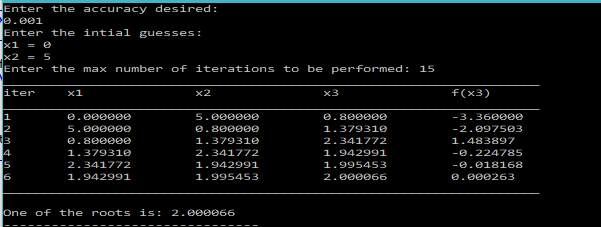
OUTPUT:

I’m a physicist specializing in computational material science with a PhD in Physics from Friedrich-Schiller University Jena, Germany. I write efficient codes for simulating light-matter interactions at atomic scales. I like to develop Physics, DFT, and Machine Learning related apps and software from time to time. Can code in most of the popular languages. I like to share my knowledge in Physics and applications using this Blog and a YouTube channel.